01
Financial services
Account questions and routine requests with the audit trail regulators expect.
Conversations at real volume, grounded in your knowledge base, with role-based access and audit logs a security team can sign off on.
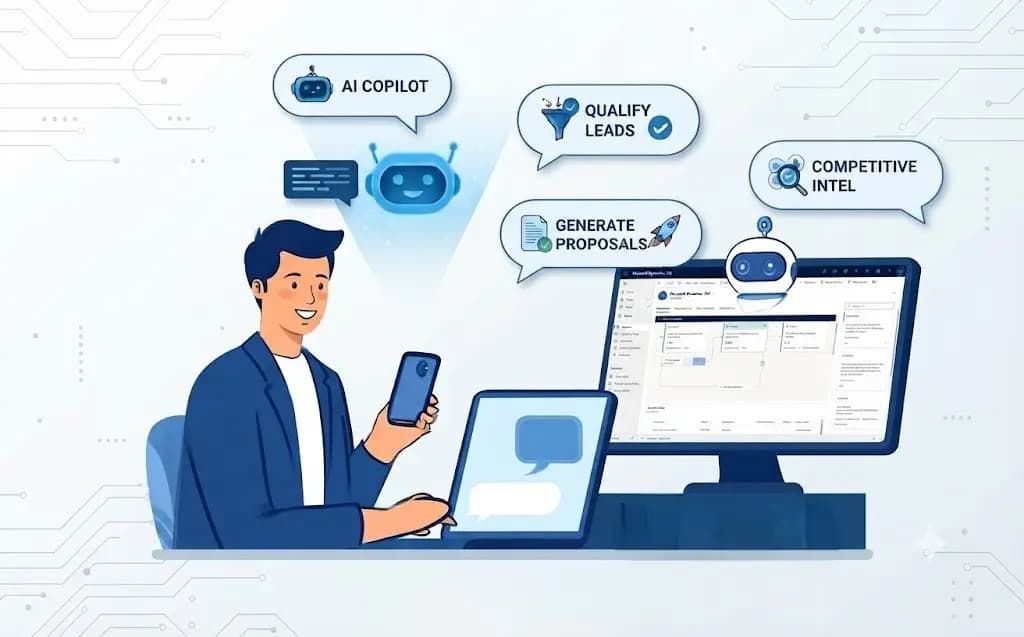
A chatbot that works for a small team's website often falls apart across an entire organization. Enterprise chatbots are built for that scale from the start — thousands of concurrent conversations, the systems a large company already runs, and access controls and audit trails a security team will actually approve.
Whether you call it an enterprise AI chatbot or part of a conversational AI platform, the requirement is the same: it has to hold up under real enterprise conditions, not a demo. Answers are retrieval-grounded in your knowledge base, not invented.
This is not ChatGPT Enterprise. ChatGPT Enterprise is a general-purpose assistant with enterprise privacy. An enterprise chatbot platform is purpose-built for customer support or employee self-service, with deeper integration into the systems that use case depends on. Related work: Customer Support Agents, AI HR Assistant, AI Sales Assistant.
The teams that look into chatbot software usually recognize a few of these.
Especially outside business hours.
There is no single place to get an instant answer.
They start breaking down under real load.
No proper access controls or audit logging.
No consistent experience or shared context.
An enterprise chatbot is an AI-powered conversational tool built for large organizations — customer or employee conversations at the scale, security, and reliability a big company needs.
What separates it from a basic chatbot is not the conversation itself. It is role-based access, full audit logs, integration with the dozen-plus systems an enterprise already runs, and the ability to hold up under thousands of simultaneous conversations. Conversational AI platforms are the broader category; “enterprise chatbot” usually points at support and employee assistance rather than voice AI generally.
Four common types: rule-based, retrieval-based, generative AI-based, and hybrid. CloudSwift typically deploys a hybrid: NLU plus RAG from your documentation, with escalation when confidence is low.
| Technology | Role | Use case | Benefit |
|---|---|---|---|
| Enterprise conversational AI platforms | Large-scale, secure conversational deployments | Rasa, IBM watsonx Assistant, and similar | Governance and customization out of the box |
| Contact-center-integrated chatbots | Live beside voice and messaging support | Existing customer communication stacks | Fits current support workflows |
| RAG-based knowledge retrieval | Pull answers from your documentation | Reducing hallucinated or outdated answers | Responses grounded in current information |
| Multilingual NLU | Detect and respond in the user's language | Global organizations | Consistent quality, not English-only |
| Cloud-native chatbot infrastructure | Scalable backend for high volume | Seasonal or unpredictable load | Scales with demand |
The right enterprise chatbot platform depends on use case, stack, and security — from deep customization to turnkey contact-center tools.
Account questions and routine requests with the audit trail regulators expect.
Scheduling and administrative questions — not clinical advice.
Order status, returns, and product questions at peak volume.
Tiered support that resolves common issues before a human agent.
Select a stage to read how it runs.
Identify the use case — customer support, employee self-service, or both — and conversation volume.
Who can see conversation data is controlled.
Every interaction is recorded.
Configurable data retention aligned to your requirements.
Some jurisdictions require telling users they are talking to a bot. We design for that. Named certifications are cited only where verified.
Built for real enterprise scale and security.
Integrates with what you already run.
Nothing sensitive is handled without human oversight when it should not be.
An enterprise chatbot is an AI-powered conversational tool built for large organizations, handling customer or employee conversations at scale with enterprise-grade security, integrations, and governance controls.
Chatbots are commonly grouped into rule-based, retrieval-based, generative AI-based, and hybrid chatbots combining multiple approaches.
ChatGPT Enterprise is a general-purpose AI assistant with enterprise privacy controls, while an enterprise chatbot platform is typically purpose-built for a specific use case with deeper system integration.
No, AI chatbots are legal, though some jurisdictions require disclosing to users that they are talking to a bot, particularly in certain regulated industries.
The right platform depends on the specific use case, existing tech stack, and security requirements, ranging from highly customizable platforms to more turnkey integrated solutions.
Enterprise chatbots use multilingual natural language understanding to detect and respond in a user's language, maintaining consistent support quality across languages.
Enterprise chatbots are trending toward more agentic behavior, taking actions across connected systems, alongside deeper integration with organizational data through retrieval-augmented generation.
Most enterprise chatbot platforms integrate with common CRM, HRIS, and ticketing systems, either natively or through a connected API.
Yes, a properly configured enterprise chatbot can detect a user's language and respond accordingly, supporting a global organization without separate chatbots per language.
It escalates the conversation to a human agent, ideally with relevant context already gathered.
Enterprise chatbots typically include role-based access controls, full audit logging, and configurable data retention policies that standard chatbots usually don't offer.
Timelines vary based on integration complexity, but a focused deployment covering one primary use case can typically launch within a few weeks to a couple of months.