01
SaaS and technology
High-velocity pipelines where lead response time is tied to conversion.
CRM updates, follow-ups, and lead scoring — handled by an agentic AI sales assistant, with the control your reps actually want.
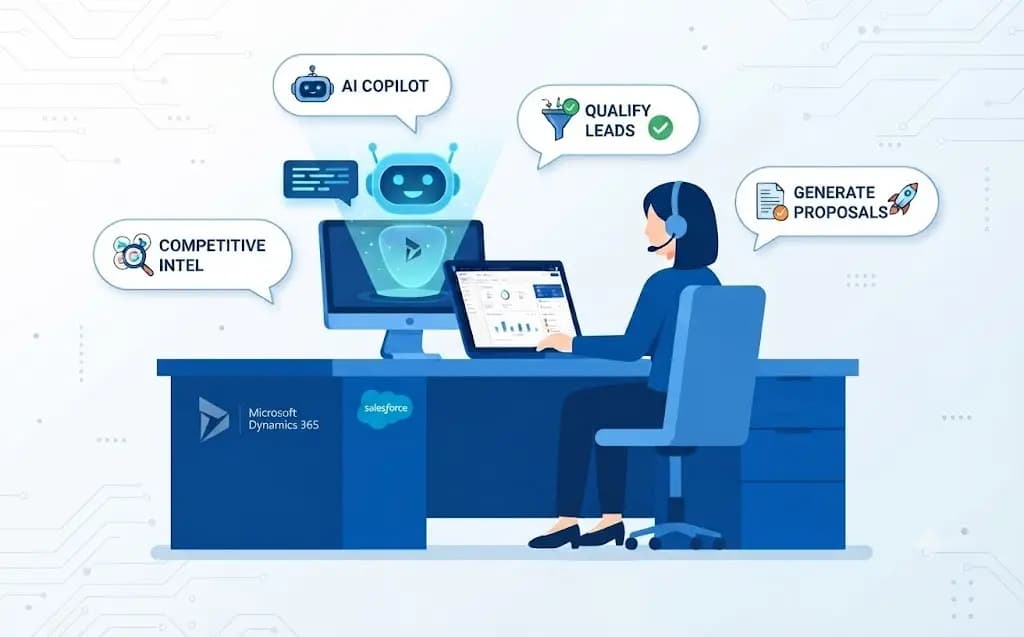
Sales teams do not lose deals because reps cannot sell — they lose time reps could have spent selling on CRM data entry, follow-up emails, and figuring out which leads are worth a call. An AI sales assistant takes that weight off.
It handles the repetitive parts of the process: logging activity, scoring leads, drafting outreach, summarizing calls, and keeping the pipeline current. Newer tools in this space are agentic AI sales assistants — they do not just suggest the next step; they can take it, within limits you set.
This is not an AI SDR. An AI SDR typically runs outbound prospecting end to end. The assistant sits inside your existing CRM workflow. Teams that also need a customer-facing bot often pair this with Enterprise Chatbots or Customer Support Agents.
Most sales teams feel this problem long before they name it. A few patterns show up again and again.
Activity logging eats the week. The assistant is built to make that part of the job disappear.
Nobody got to them in time. Automated scoring and first-touch drafting close that gap.
An AI sales assistant drafts the message so the rep is not starting from a blank page.
Managers cannot get a clean read because the data behind it is messy.
An AI sales assistant platform extends a small team's capacity without a dedicated ops hire.
An AI sales assistant is a tool that supports a human sales rep's day-to-day work using AI. It is not the same as an AI SDR, which typically runs outbound prospecting on its own from start to finish.
Think of it as something that sits inside your existing workflow: it watches deal activity, flags what needs attention, drafts the message, and updates the CRM. An AI sales agent is a broader term that can mean this kind of assistant or a fully autonomous system. “Assistant” still generally implies a human stays in the loop.
An AI sales copilot usually emphasizes working alongside a rep in real time — on a call or while drafting. “Assistant” is often used more broadly to include background automation too. CloudSwift sets the level of autonomy your team wants, including Salesforce, HubSpot, and Pipedrive AI sales assistant setups.
| Technology | Role | Use case | Benefit |
|---|---|---|---|
| CRM-native AI assistants | Built into the CRM your team already uses | Salesforce Einstein, HubSpot Breeze, Pipedrive AI | Fastest path to adoption — no new login for reps |
| Conversation intelligence | Analyzes calls for talk-time, objections, and next steps | Coaching and deal-risk detection | Turns recordings into structured data |
| Sales engagement with AI | Automates and personalizes multi-step outreach | Follow-up and nurture at scale | Consistent touchpoints without manual sending |
| Agentic AI sales assistant tools | Take actions within defined guardrails, not just suggestions | Teams ready to hand off routine tasks | More time saved than a suggestion-only copilot |
| General AI copilots | Assist across email, calendar, and CRM | Teams on Microsoft 365 or Google Workspace | Lower training overhead |
Best AI sales assistant software depends on the CRM you already run. We configure around that stack instead of forcing a migration.
High-velocity pipelines where lead response time is tied to conversion.
Following up with buyer and seller leads faster than a competing agent.
Renewal and cross-sell across a large existing book of business.
Supporting advisors while keeping activity logs audit-ready.
Select a stage to read how it runs.
Map the current sales workflow and where time is being lost.
Role-based access to CRM data.
A record of every automated action the assistant takes.
Configurable limits on what the assistant can send or update without a rep's review.
Strict consent contexts need a dedicated compliance review beyond standard assistant setup. Named certifications are cited only where verified.
No forced migration.
Built around agentic AI sales assistant capabilities your reps do not have to act on by hand every time.
Assistant support versus full outbound automation — you get the level of autonomy the team wants.
An AI sales assistant is software that uses AI to support a sales rep's daily work, automating CRM updates, drafting follow-ups, scoring leads, and summarizing calls.
An AI sales assistant typically supports a human rep's existing workflow, while an AI SDR more often runs outbound prospecting autonomously from start to finish.
AI sales agent is a broader term spanning assistant-style tools to fully autonomous systems, while assistant usually implies a human stays in the loop.
AI is shifting sales work away from manual admin toward more time spent on actual selling, with AI handling the repetitive administrative layer.
Key benefits include time saved on administrative work, faster lead response times, more consistent CRM data, shorter rep ramp time, and scaling pipeline coverage without proportional headcount growth.
Most AI sales assistants integrate with major CRMs like Salesforce, HubSpot, and Pipedrive, either natively or as a connected tool.
An agentic AI sales assistant can take actions on its own, such as sending a follow-up or updating a deal stage, within defined guardrails.
They're closely related; copilot usually emphasizes real-time support during a call or while drafting, while assistant is often used more broadly.
Yes, smaller teams often see the biggest relative benefit since an assistant can extend limited capacity without a dedicated ops person.
Timelines vary by CRM complexity, but a focused pilot with one team can typically be running within a few weeks.
Most AI sales assistants are built to support reps rather than replace them, automating administrative work so reps focus on judgment-driven selling.
Savings are typically measured in rep time recovered from CRM entry and follow-up drafting, varying by team size and prior process maturity.