01
Financial services
Credit, fraud, and risk models with audit-ready drift logs.
Drift detection and performance tracking on production data — so a live model does not fail quietly in the background.
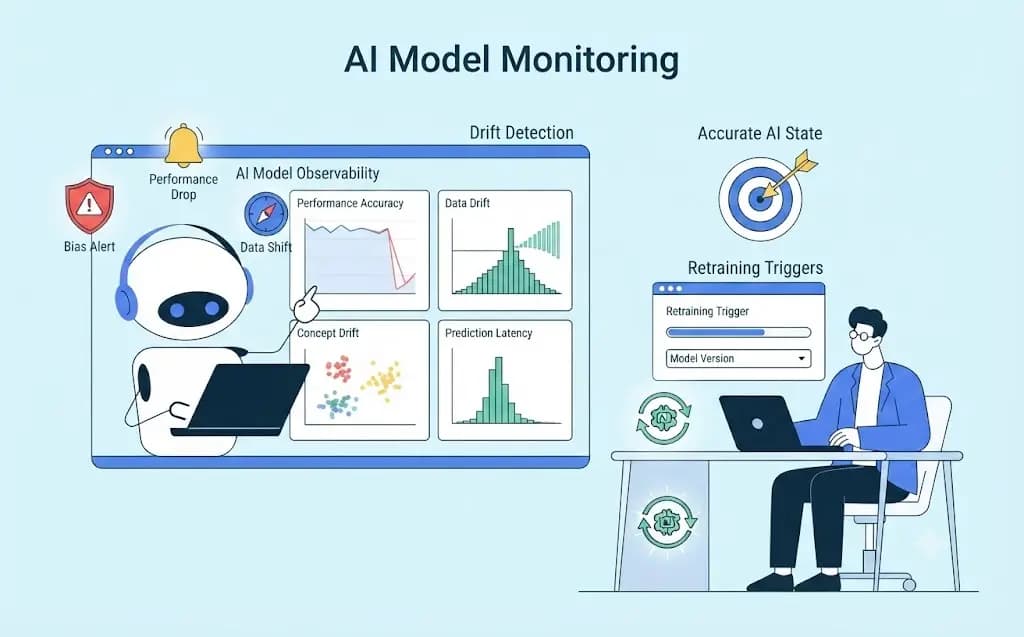
AI model monitoring is the ongoing process of tracking a deployed model's predictions, performance, and input data in production to detect accuracy degradation, model drift, or data quality problems.
It is the stage that follows AI model deployment — where model monitoring becomes the safety net that keeps a live model trustworthy instead of quietly failing. As part of a broader ML model monitoring practice, that means continuous tracking, alerting, and a clear path to retraining or rollback.
CloudSwift sets up drift detection grounded in your production data, including Vertex AI model monitoring, SageMaker Model Monitor, and Azure where you already deploy. Pair this with AI Model Deployment when the model is not in production yet.
Teams rarely notice a model has degraded until the damage is already visible in a business metric.
No one is watching how the model performs on live data.
Real-world data moves away from the training distribution. Model drift detection exists to catch that.
Latency is green while prediction quality is not. Generic observability is not ML model monitoring.
Problems show up as a complaint or a bad outcome, not a dashboard.
Nothing proves production models are being actively watched.
AI model monitoring is the continuous tracking of a deployed model's predictions, performance metrics, and input data to detect when behavior changes or degrades.
It is distinct from AI model deployment, which is getting a model into production, and from model observability, which includes monitoring plus the tooling to investigate why a model is behaving a certain way.
Model drift detection — spotting when incoming data or predictions have shifted from training — is the core mechanism most monitoring is built around. Cloud-native options include Vertex AI model monitoring for teams already on Google Cloud.
| Technology | Role | Use case | Benefit |
|---|---|---|---|
| Model monitoring platforms | Track drift, data quality, and model performance | Evidently AI, Fiddler AI, Arize AI, WhyLabs | Model-specific detection generic observability misses |
| General observability | Extend infra monitoring with ML metrics | Datadog, Prometheus, Grafana | Single pane across infra and model health |
| Cloud-native monitoring | Managed drift and performance on the deploy platform | Vertex AI model monitoring, SageMaker Model Monitor, Azure | Less setup when you already deploy there |
| Statistical drift methods | Quantify data and prediction drift | PSI, KL divergence, Wasserstein distance | Statistically grounded alerting, not arbitrary thresholds |
Alerting and incident tooling turns a drift signal into a response — investigate, retrain, or roll back.
Credit, fraud, and risk models with audit-ready drift logs.
Clinical decision-support models with alerting tied to safety thresholds.
Recommendation and pricing models where drift hits revenue.
LLM-powered features for output quality drift as usage evolves.
Select a stage to read how it runs.
Inventory deployed models and any monitoring already in place.
Logged alerts and drift events for governance reviews.
Who can view or act on monitoring data is role-based.
Retraining decisions are tied to monitoring signals, not ad hoc judgment.
SOC 2, HIPAA, or ISO 27001 are cited only where formally verified.
Not arbitrary thresholds.
LLM monitoring included, not only accuracy on labels.
Vertex AI model monitoring, SageMaker, Azure, or dedicated AI model monitoring tools.
AI model monitoring is the ongoing process of tracking a deployed model's predictions, performance, and input data in production to detect degradation, drift, or data quality issues.
Model drift is when a model's performance degrades because real-world data or patterns have shifted away from what the model was trained on.
Model monitoring tracks predefined metrics and alerts on threshold breaches; model observability is the broader practice of also investigating why a model is behaving a certain way.
Data drift is a change in the input data's distribution; concept drift is a change in the relationship between inputs and the correct output.
Vertex AI model monitoring is Google Cloud's built-in monitoring capability for models deployed on Vertex AI, tracking training-serving skew and prediction drift natively.
LLM monitoring often tracks output quality, relevance, and safety signals rather than a single accuracy metric, since generative outputs don't have one correct answer.
Most monitoring platforms check continuously or on a rolling basis, with alerts triggered when a statistical threshold is crossed rather than at fixed intervals.
Typically a drift or performance metric crossing a predefined threshold triggers a review, after which a team decides on retraining, rollback, or another intervention.
Yes — many teams extend general observability platforms with model-specific metrics, though dedicated ML monitoring tools typically offer deeper drift-detection capabilities.
Common metrics include prediction accuracy over time, data drift scores such as PSI or KL divergence, latency, and precision/recall on labeled samples as they become available.
Requirements vary by industry, but regulated sectors like financial services and healthcare increasingly expect documented, ongoing monitoring of production models.
An AI model monitoring platform is software that tracks a deployed model's performance and drift, and alerts teams when something changes, whether managed, self-hosted, or cloud-native.
ROI is typically measured by comparing monitoring costs against the cost of undetected model failures, including lost revenue, compliance penalties, and engineering time saved through automated detection.
Continuous monitoring creates an auditable record of model behavior over time that governance and compliance teams can point to as evidence a model is being actively overseen.